
TL;DR: Agentic commerce lets AI agents browse, decide, and buy on behalf of your fans — no manual checkout required. McKinsey projects $2.3 trillion in agent-transformed retail by 2026, with creators positioned to capture $50–100 billion of that. You don't need to rebuild your store. You need to make it agent-readable. This guide breaks down the protocols, platforms, and moves that matter right now.
What Is Agentic Commerce?
Forget browsing. Forget adding to cart. Agentic commerce for creators changes everything about how products get discovered and bought.
Here's the short version: your fans tell an AI agent what they want. The agent searches, compares, and buys — all without a single click from the human.
Think of it as delegation. Your audience sets guardrails (budget, style, category). The AI handles the rest. It remembers past preferences, tracks new drops, and completes checkout autonomously.
Quotable: Agentic commerce deploys autonomous AI agents that independently browse catalogs, evaluate options, and complete transactions without continuous human oversight.
This isn't chatbot shopping. Conversational commerce still needed humans to confirm every step. Agentic commerce gives the AI real authority — within limits your fans define.
Three pillars make it work:
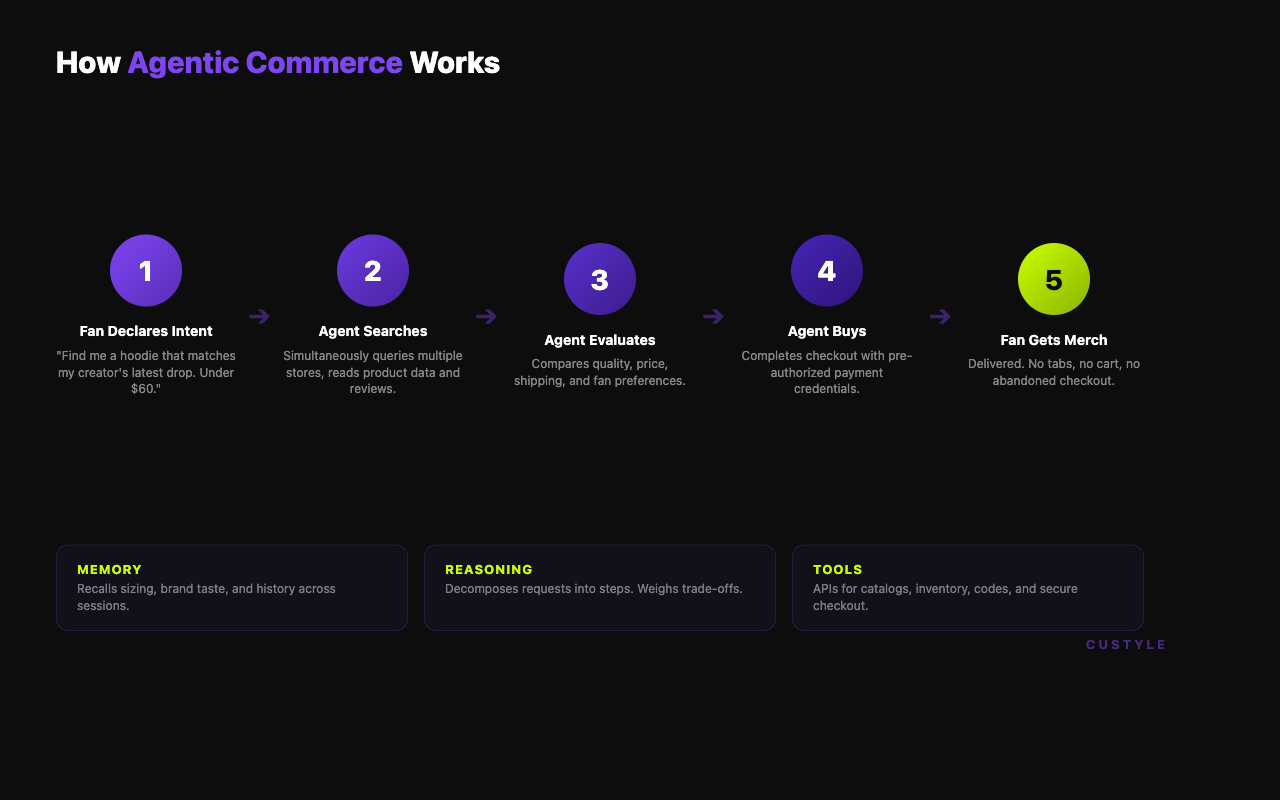
- Memory. The agent recalls sizing, brand taste, and purchase history across sessions.
- Reasoning. It decomposes requests into steps and weighs trade-offs.
- Tools. APIs let it search catalogs, check stock, apply codes, and execute checkout.
The result? Your merch reaches fans at the exact moment their intent sparks — not when they happen to scroll past your link.
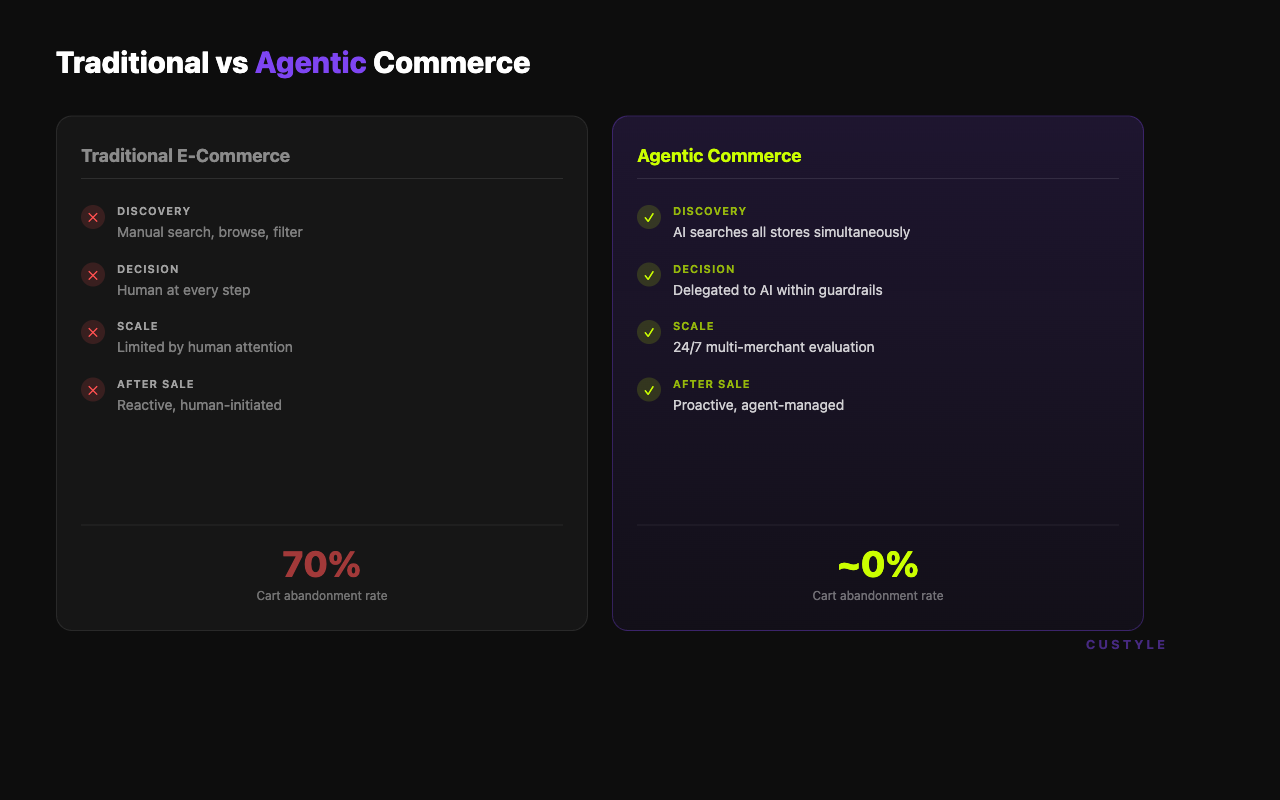
| Dimension | Traditional E-Commerce | Conversational Commerce | Agentic Commerce |
|---|---|---|---|
| User action | Manual search and filter | Chat-guided, human-confirmed | Intent declared, AI executes |
| Decision maker | Human at every step | Human with AI help | AI within set rules |
| Scale | Limited by human time | Slightly faster | Simultaneous multi-store search |
| After purchase | Reactive, human-initiated | Limited automation | Proactive, agent-managed |
| Cart abandonment | 70% industry average | Reduced friction | Near-zero |
According to McKinsey, this is "not just an evolution of ecommerce... It's a rethinking of shopping itself."
-> Related: What Is an AI Merch Agent?
Why Creators Should Care
You already fight for attention. Algorithm changes tank reach overnight. Ad costs keep climbing. Merch links get buried.
Agentic commerce flips the script. Instead of hoping fans click your bio link, their AI agents actively seek your products. Your store becomes discoverable by machines, not just humans.
Quotable: In the agentic era, discoverability by AI becomes as critical as discoverability by humans.
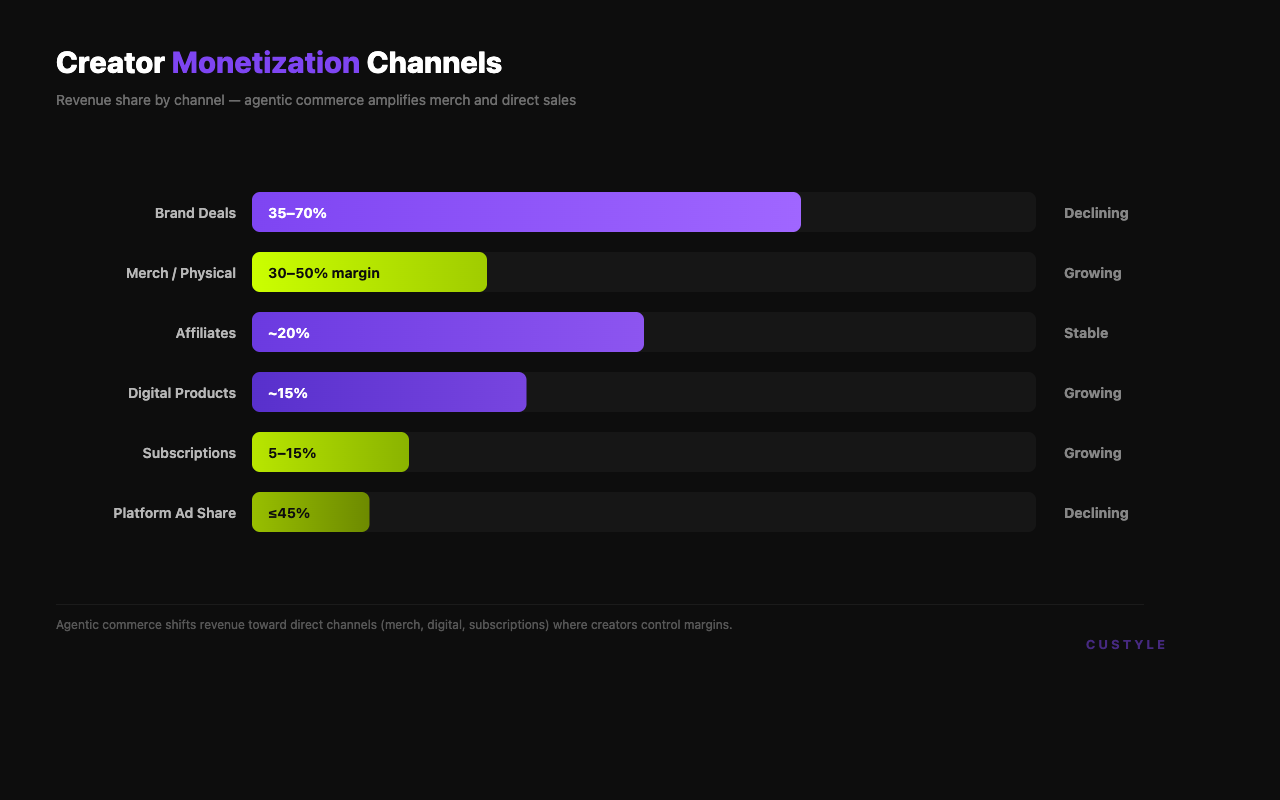
The creator economy hit $250 billion in 2025 (growing 22.9% annually). But most creators still earn less than they deserve. Revenue splits favor platforms. Merch margins beat ad revenue — 30–50% on merchandise versus 55% or less kept by platforms.
Agentic commerce solves the three biggest creator pain points:
| Challenge | Old Reality | Agentic Solution |
|---|---|---|
| Operational burden | You handle fulfillment, service, pricing | AI agents automate design, production, pricing, service |
| Platform dependency | One algorithm change kills your revenue | Direct agent relationships bypass platform gatekeepers |
| Audience fragmentation | Rising ad costs, declining organic reach | Agents find your products across platforms automatically |
Later's Chief Strategy Officer Lyle Stevens predicts: "2026 will be the year creator marketing fully matures into creator commerce."
Your vibe attracts your audience. Now AI agents make sure they find your merch without friction.
The Numbers Tell the Story
The data is stacking up fast. Every major research firm agrees: agentic commerce is not a maybe.
Global Market Projections
| Source | Metric | 2026 | 2030 |
|---|---|---|---|
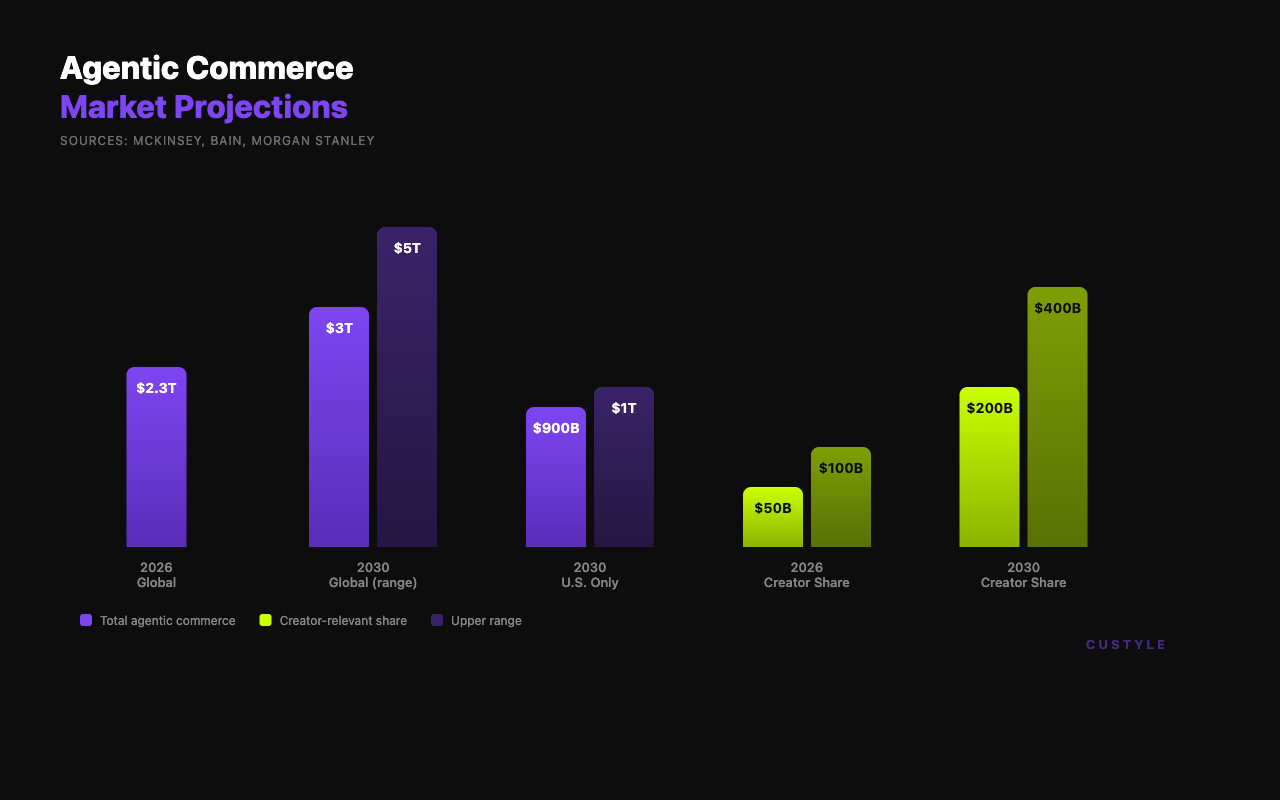
| McKinsey | Global agent-transformed retail | $2.3 trillion | $3–5 trillion |
| McKinsey | U.S. orchestrated revenue | — | $900B–$1 trillion |
| Bain & Company | U.S. agent commerce | — | $300–500 billion |
| MetaRouter/Bain | Global volume | — | $5 trillion |
| Morgan Stanley | U.S. agent-driven spending | — | $190–385 billion |
Creator Economy Growth
| Metric | Value | Source |
|---|---|---|
| Creator economy 2025 | $250 billion | Industry estimates |
| Projected 2027–2030 | $480–528 billion | 15–20% CAGR |
| Social commerce creator revenue 2026 | $20.6 billion (16.2% growth) | eMarketer |
| Top 10% creator monthly earnings | $48,500 | Industry data |
| Merch margins | 30–50% | Direct commerce data |
AI Shopping Adoption Velocity
| Signal | Data Point | Source |
|---|---|---|
| Shopify AI traffic growth | 7x since January 2025 | Shopify |
| AI-facilitated purchases on Shopify | 11x increase | Shopify |
| Black Friday 2025 AI traffic surge | 805% year-over-year | Adobe |
| Cyber Week 2025 agent-involved orders | 1 in 5 (~$70B GMV) | McKinsey |
| Generative AI traffic growth (July 2025) | 4,700% year-over-year | Industry data |
Quotable: Shopify reports a sevenfold increase in AI-driven traffic and an 11x increase in AI-facilitated purchases since January 2025, signaling that agentic commerce adoption is accelerating faster than mobile commerce did in its early years.
The creator-relevant slice? Three independent estimation methods converge on 15–25% of total agentic commerce. That implies $50–100 billion in creator-influenced agentic commerce by 2026, growing to $200–400 billion by 2030.
Your fans are already shopping with AI. The question is whether your merch shows up when they do.
How It Actually Works
Picture this. Your fan says to their AI agent: "Find me a hoodie that matches the vibe of my favorite creator's latest drop. Under $60. Ship by Friday."
The agent:
- Searches your store and competing stores simultaneously.
- Evaluates product reviews, sizing data, and design quality.
- Checks stock and shipping timelines.
- Compares total cost including discounts.
- Completes checkout with pre-authorized payment.
No tabs. No cart. No abandoned checkout. Your fan gets exactly what they described — and you get the sale.
This goes beyond one-time purchases. Predictive commerce anticipates needs before fans even ask.
Julie Towns, VP of Product Marketing at Pinterest, puts it clearly: "You'll see the biggest impact in planning-driven, repeatable decisions: Outfits, rooms, gifting, seasonal refreshes, even weekly shopping."
For creators, this means:
- Drop alerts turn into auto-purchases. Fans set agents to buy your new releases automatically.
- Replenishment becomes passive. Consumable merch (stickers, prints) gets reordered before fans run out.
- Gift-giving gets smarter. Agents match your products to occasions in your fans' lives.
Your intent becomes the starting point. The agent makes it real.
Protocols You Need to Know
Five protocols form the backbone of agentic commerce for creators. You don't need to code them. You need to understand what they unlock.
| Protocol | Sponsor | What It Does | Why You Care |
|---|---|---|---|
| MCP | Anthropic | Standardized tool and data access for AI agents | Makes your store discoverable by any MCP-enabled agent |
| ACP | OpenAI + Stripe | Secure agent-mediated checkout | Fans buy your merch directly inside ChatGPT |
| A2A | Multi-agent coordination | Fan agents negotiate with your store's agent | |
| UCP | Modular shopping standard | 28% of retailers already adopted; Google AI Mode integration | |
| AP2 | Google + PayPal | Cryptographic payment authorization | Secure "standing intents" for recurring agent purchases |
The Big One: ACP (Agentic Commerce Protocol)
In September 2025, OpenAI and Stripe launched the Agentic Commerce Protocol. It lets fans complete purchases directly inside ChatGPT. Etsy and over one million Shopify merchants went live on day one.
Will Gaybrick, Stripe's President of Technology, framed it: "Stripe is building the economic infrastructure for AI... a future where agent-led transactions are the norm."
Quotable: The Agentic Commerce Protocol (ACP) by OpenAI and Stripe enables direct in-conversation purchases, with over one million Shopify merchants already live — making it the fastest-adopted commerce protocol in history.
MCP: Your Store's Agent API
Think of MCP as giving AI agents a universal menu for your store. Instead of building custom integrations, you expose structured data through standardized endpoints. Any MCP-enabled agent can find, evaluate, and purchase your products.
This levels the playing field. A creator running a Shopify store with MCP endpoints competes for agent-mediated purchases on the same footing as major retailers.
UCP: Google's Play
Google launched the Universal Commerce Protocol in January 2026. Already at 28% retail adoption. If you're not UCP-visible, you're invisible to Google's AI Mode shopping agents.
The message is clear: get protocol-compliant or get filtered out.
-> Related: How to Make Your Store Agent-Ready
Platform Landscape: 2026
Not every platform treats agentic commerce the same. Here's where things stand.
Traditional Platforms Adding AI
| Platform | Agentic Readiness | Key Capabilities | Creator Features |
|---|---|---|---|
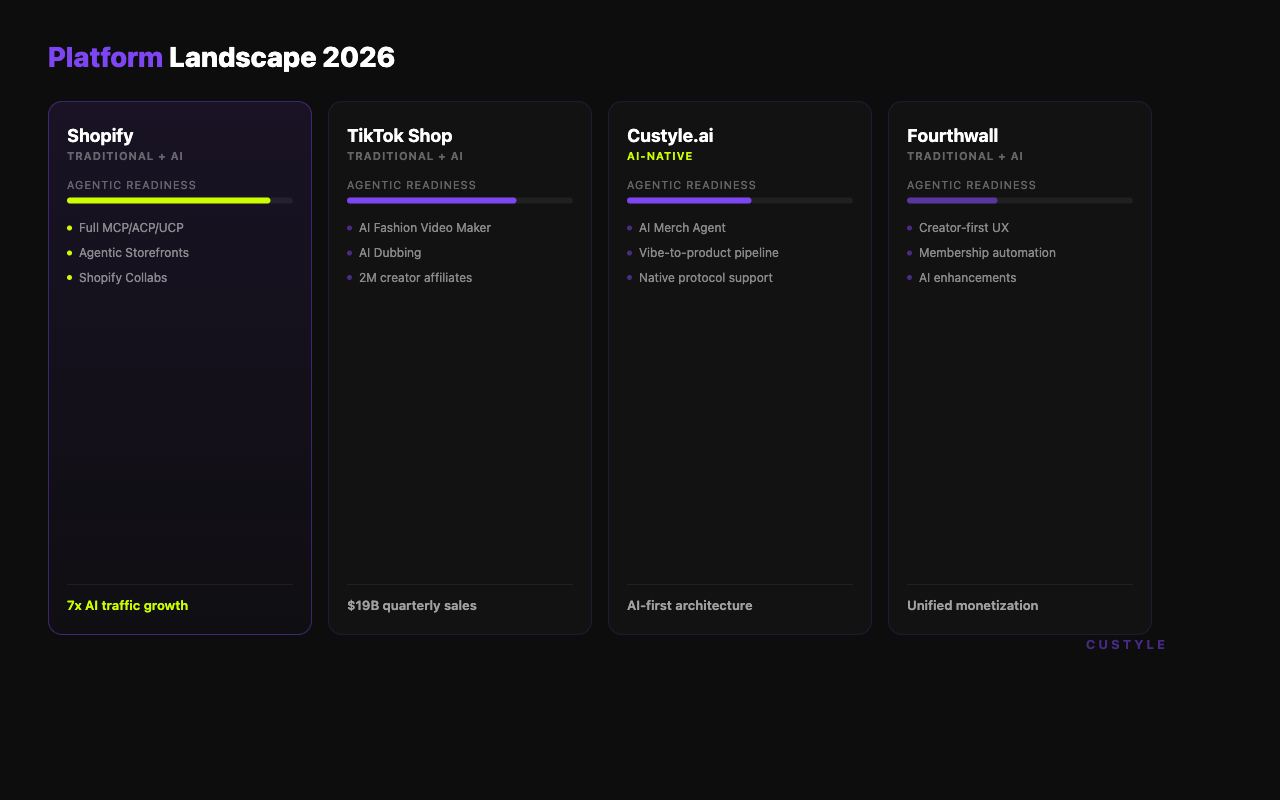
| Shopify | Highest | Agentic Storefronts, MCP/ACP/UCP support | Creator templates, Shopify Collabs |
| TikTok Shop | High | AI Fashion Video Maker, AI Dubbing, List with AI | 2M creator affiliate program |
| Spring | Medium | On-demand production, automated fulfillment | Simplified merch, zero inventory risk |
| Fourthwall | Medium | Membership automation, AI enhancements | Creator-first UX |
AI-Native Platforms
| Platform | What It Does | Stage |
|---|---|---|
| Custyle.ai | AI Merch Agent — turns your vibe into production-ready merch | Early |
| Flockx | Creator commerce agent with AI-to-AI commerce | Operational |
| Recomaze.ai | AI catalog optimization for Shopify | Production |
| Flytask | TikTok trend automation agents | Production |
Custyle.ai represents a different approach entirely. Instead of adding AI features to an existing store, it starts with AI as the foundation. You describe a vibe, and the AI crew handles design, product matching, and fulfillment. It's agentic commerce for merch from the ground up — built so AI shopping agents can discover and transact with your products natively.
Traditional + AI vs. AI-Native
| Dimension | Traditional + AI | AI-Native |
|---|---|---|
| Architecture | AI added to existing systems | AI as foundational design |
| Protocol support | Progressive adoption | Native from day one |
| Scale | Established merchant networks | Emerging, growing fast |
| First-mover window | Closing | Open but narrowing |
TikTok Shop's numbers tell their own story: $19 billion in quarterly global sales with 125% U.S. quarter-over-quarter growth. Their recommended content split — 70% human-created, 30% AI-assisted — balances authenticity with scale.
Your Fans Already Trust AI
Skeptical that your audience will let AI buy for them? The data says otherwise.
Gen-Z and Millennial Adoption
| Metric | Figure |
|---|---|
| Consumers currently using AI when shopping | 38% |
| Gen-Z who used AI for purchases (past year) | 61% |
| Gen-Z preferring AI for product research | 33% (near parity with 37% for search) |
| Millennials planning AI holiday shopping | 52% |
| Consumers expecting increased AI shopping use | 80% |
| Gen-Z comfortable with AI making final purchase decisions | 34% (3x older demographics) |
| Gen-Z willing to let AI buy without approval | 28% |
Quotable: According to IAB research, 61% of Gen-Z consumers used AI tools for purchases in the past year, and 28% would allow AI to complete purchases without any human approval — a comfort level that drops to 0% among Boomers.
Trust Delegation Spectrum
| Trust Level | Comfort Rate |
|---|---|
| AI researching options | 85% |
| AI generating a shortlist | 82% |
| AI choosing the best option | 70% |
| AI buying with set rules (agentic) | 47% |
| Open to agent-made purchases (Salesforce) | 48% |
The pattern is clear. Your youngest, most engaged fans are already comfortable letting AI handle purchases. As trust builds, autonomous buying spreads.
One gap matters: 89% still verify before buying. But that percentage shrinks with every positive agent experience. The creators who train their fans on agent-ready shopping now will own this channel early.
Merch Gets an Upgrade
Agentic commerce doesn't just change how merch sells. It changes how merch gets made.
AI Merch Agents in Action
| Function | What AI Does | Result |
|---|---|---|
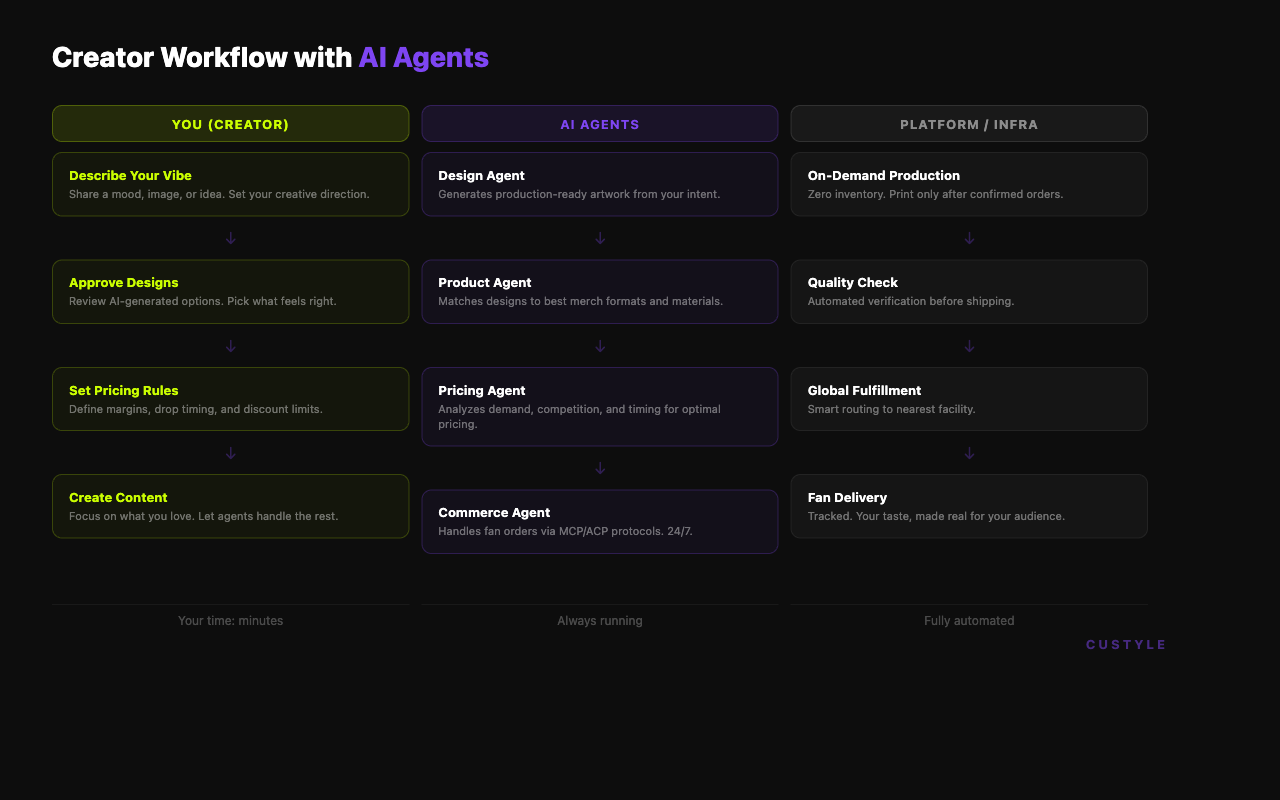
| Design | Analyzes your content, audience taste, and trends to create production-ready art | Concept to sample: weeks to hours |
| Production | Selects manufacturers, generates files, monitors quality | Zero inventory risk, unlimited SKU variety |
| Fulfillment | Picks shipping partners, tracks delivery, handles exceptions | Faster delivery, lower cost |
| Pricing | Adjusts based on demand, competition, and timing | Higher margins on drops, better volume pricing |
This is where platforms like Custyle.ai shine. Describe your vibe — a mood, an aesthetic, a reference image — and the AI crew handles the rest. Design gets made for merch (not just for screens). Products get matched to the right format. Production and shipping happen automatically. Your taste becomes tangible, and AI shopping agents can discover it from the moment it goes live.
On-Demand Manufacturing
Zero inventory changes the game for creators:
- No upfront costs. Production starts only after a confirmed order.
- Unlimited variety. Test 100 designs with zero risk.
- Dynamic batching. Volume discounts without delivery delays.
- Real-time evolution. Update designs based on live feedback.
Beyond Merch
Agentic commerce transforms every creator revenue stream:
| Revenue Stream | Agentic Enhancement |
|---|---|
| Digital products | AI-generated landing pages, conversion-optimized checkout |
| Courses | Adaptive learning paths, dynamic content sequencing |
| Subscriptions | Predictive churn prevention, automated tier optimization |
| Fan monetization | Context-aware tipping, cross-platform relationship tracking |
-> Related: From Taste to Tangible — How AI Merch Works
Risks Worth Watching
Agentic commerce is moving fast. That speed brings real risks.
Technical Risks
| Risk | What Happens | Your Move |
|---|---|---|
| Agent hallucination | AI misidentifies products, misreads prices | Use structured product data with clear attributes |
| Stale inventory data | Failed transactions, disappointed fans | Enable real-time stock webhooks |
| API outages | Agents can't reach your store | Build graceful fallbacks, queue orders |
Legal Gray Zones
No jurisdiction has passed comprehensive agentic commerce liability law yet. Key questions remain open:
- Who's liable for wrong orders? The fan, the agent, or the merchant?
- Contract autonomy: Can an AI legally bind a purchase?
- Data governance: 43% of consumers would stop engaging if they perceived data misuse.
Regulatory Timeline
| Regulation | Date | Impact |
|---|---|---|
| EU AI Act | August 2026 | Risk management, transparency, human oversight requirements |
| Colorado AI Act | June 2026 | Algorithmic discrimination prevention |
| GDPR intersection | Ongoing | Cross-border agent data rules |
| Maximum EU penalty | — | Up to 35 million euros or 7% global revenue |
Quotable: The EU AI Act, taking effect August 2026 with penalties up to 35 million euros or 7% of global turnover, will establish the first comprehensive regulatory framework for AI commerce agents.
Diarmuid Gill, CTO of Criteo, keeps it grounded: "The platform can make recommendations, but you still need a human in the loop... Ultimately, I believe it's they who should be deciding what kind of experience they have."
Start with structured data. Stay transparent with your audience. Build trust gradually.
Your 2026 Action Plan
You don't need to overhaul everything. Start with these moves.
Do Now (Q2 2026)
| Priority | Action | Why It Matters |
|---|---|---|
| 1 | Make your product data MCP-compatible | Agent discoverability is table stakes |
| 2 | Activate Shopify/TikTok Shop AI features | Capture the 7x traffic growth |
| 3 | Structure your catalog with rich attributes | Agents evaluate data, not vibes |
| 4 | Tell your fans about agent-ready shopping | Build delegated purchase willingness early |
Build Next (2026–2028)
- Develop direct agent relationships beyond platform dependency.
- Adopt a 70:30 human-to-AI content split for scale.
- Unify your presence across platforms with MCP-enabled consistency.
- Test AI-native merch platforms like Custyle.ai for zero-friction drops.
Think Long-Term (2028–2030)
- Build creator-owned agent infrastructure.
- Collaborate with other creators through A2A-enabled joint releases.
- Move toward predictive commerce — anticipatory fulfillment before fans ask.
- Engage in protocol governance to protect creator interests.
Creator Action Checklist
- Audit your product data for agent readability
- Enable MCP/ACP endpoints on your store
- Structure product descriptions with use cases and comparison data
- Set up real-time inventory feeds
- Educate your audience about AI shopping benefits
- Test one AI-native platform for a merch drop
- Monitor agentic traffic in your analytics
The window is open. 85% of enterprises score below 40/100 on agentic commerce readiness. Creators who move now capture the advantage.
FAQ
What is agentic commerce for creators?
Agentic commerce for creators is a model where AI agents autonomously discover, evaluate, and purchase creator merchandise and digital products on behalf of fans. Unlike traditional e-commerce, fans set preferences and budgets, then the AI handles the entire transaction. According to McKinsey, this model will transform $2.3 trillion in retail sales by 2026.
How do AI shopping agents find my products?
AI shopping agents discover your products through standardized protocols like MCP, ACP, and UCP. These protocols expose your product data — descriptions, pricing, inventory, and attributes — in formats agents can read and evaluate. If your store isn't protocol-compliant, agents simply skip it.
Is agentic commerce safe for my fans?
Yes, with guardrails. Fans set spending limits, category restrictions, and approval thresholds. Payment protocols like AP2 use cryptographic authorization that's time-bounded and amount-capped. 48% of AI shoppers already say they're open to agent-made purchases, according to Salesforce research.
What platforms support agentic commerce right now?
Shopify leads with full MCP/ACP/UCP support and 7x AI traffic growth. TikTok Shop launched AI tools in January 2026. AI-native platforms like Custyle.ai build agent compatibility from the ground up. Over one million Shopify merchants already accept purchases through ChatGPT via the Agentic Commerce Protocol.
How much can creators earn from agentic commerce?
Three independent estimation methods suggest creators can access 15–25% of total agentic commerce volume. That implies $50–100 billion in creator-influenced agentic transactions by 2026, growing to $200–400 billion by 2030. Merch margins of 30–50% make this significantly more profitable than ad revenue splits.
Originally published on custyle.ai